

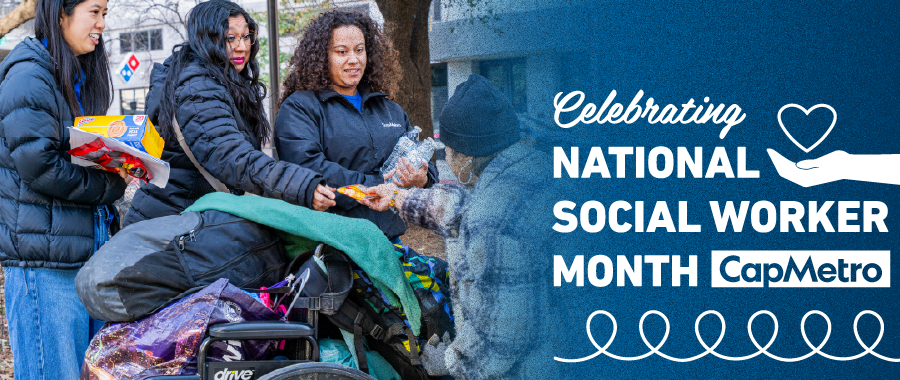
Did you know that CapMetro employs social workers? For National Social Worker’s Month, we wanted to shine some light on these dedicated individuals and their roles supporting the vulnerable communities on our transit system. From coordinating outreach, to assisting individuals experiencing homelessness or those facing challenges related to mental health conditions or substance abuse, CapMetro’s Community Intervention Specialists (CIS) are out in the field every day helping to keep our community safe.
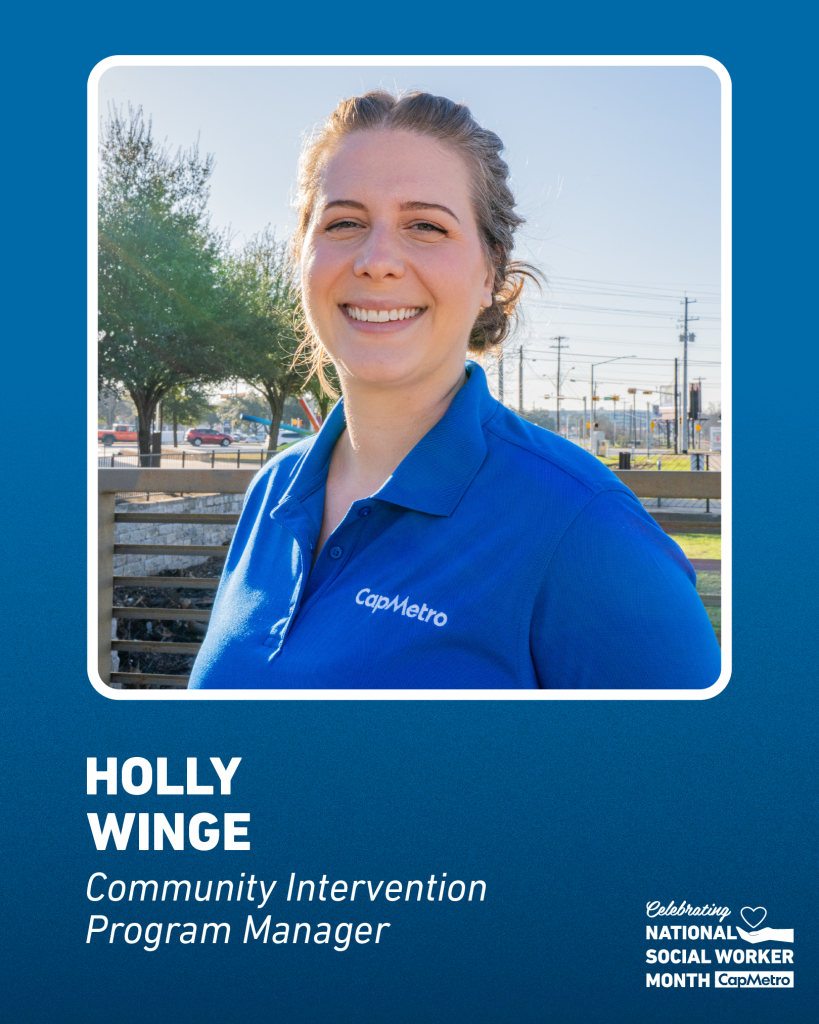
The CIS team is overseen by a Program Manager and includes three specialists who work 1-on-1 with clients who are identified along our transit system. The team comes from many different backgrounds, including experience in Child Protective Services, working with at-risk youth, human trafficking, AmeriCorps, the SAFE Alliance, intensive psychiatric care and much more. Holly Winge, the Community Intervention Program Manager, explains that she, “became passionate about advocating for underserved populations.” Holly came to CapMetro to begin building the agency’s program to address homelessness on the transit system.
The team specializes in street outreach and collaborates with social service agencies to provide comprehensive support with holistic methods. The team also trains internal staff in Mental Health First Aid.
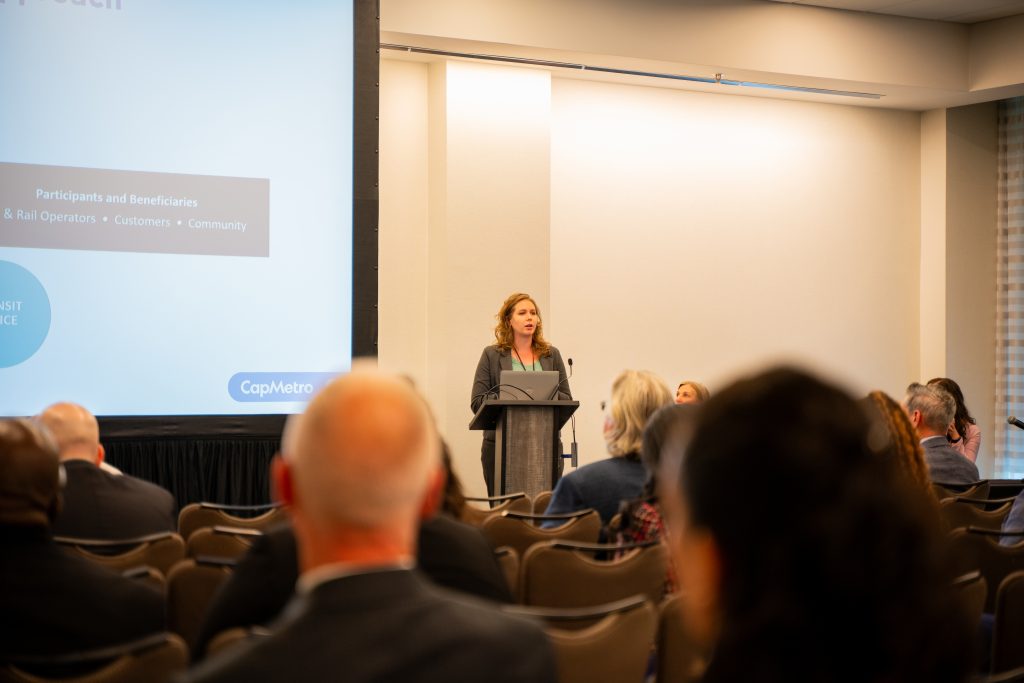
As Stacie Gutierrez, one of the Community Intervention Specialists, explains:
“We provide real-time support and help make transit a safer and more compassionate space for all. We provide clients with case management, connect them to resources that help close housing gaps, food insecurity, lack of medical care and much more. We also ensure that our clients have access to vital information, such as inclement weather warnings or CapMetro service interruptions, so they can have a plan to get to safety.”
While no day is the same, they always start with a morning meeting to discuss their cases, log referrals and manage appointments with clients. From there, the team conducts proactive outreach at hot spot locations along our system, provides necessary supplies and works with city or nonprofit partners to coordinate further efforts. They also check mail for clients, assist with receiving personal identification documents, register individuals for further assistance and make follow-up plans to check on progress and needs.
The CIS team also coordinates the agency’s Discounted Fare Programs. These programs range from reduced fare for seniors and active or reserve military ID holders to discount programs that are carefully coordinated alongside city and nonprofit partners who provide resources to vulnerable and low-income populations.
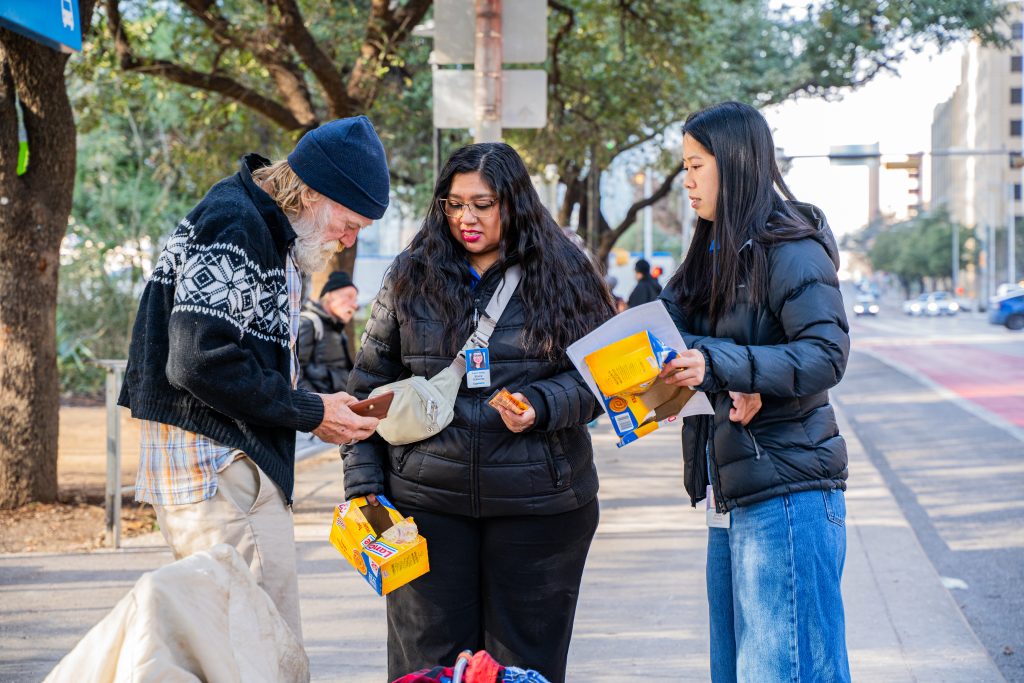
We asked the team to describe how the work they do in a transit setting differs from more traditional social work environments. Here’s what they had to say:
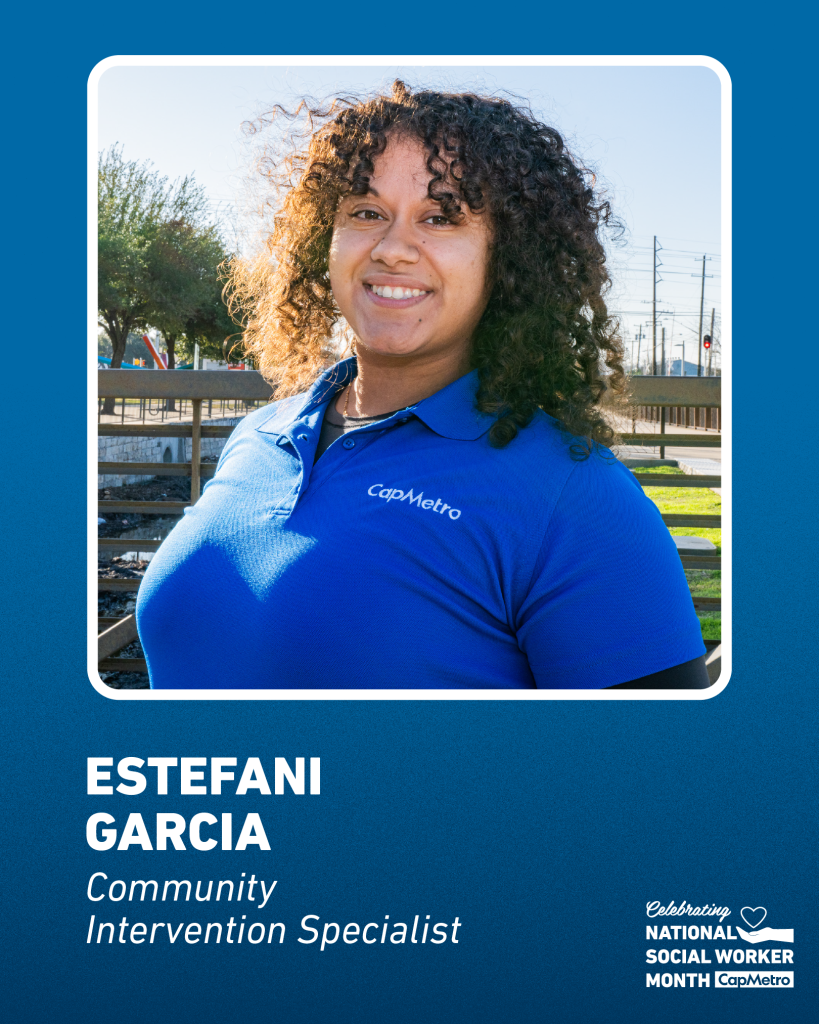
Estefani Garcia: Our team is very “boots on the ground” while case managing clients on the transit system. We get out there and search for individuals that often do not have a phone or a way to communicate. Our team is less clinical and more informal in comparison to a traditional social work setting.
Stacie Gutierrez: Our work is fast paced and, at times, unpredictable. We do not always have scheduled sessions with our clients. We respond in real time and in most cases, they are in crisis. We prioritize immediate safety, stabilization and support. Some of our clients are newly homelessness with little to no knowledge of community resources.
Carolyn Widen: A big part of my role is bringing greater awareness and psychoeducation around the needs of low-income and unhoused customers to colleagues and leadership. Since CapMetro is a government entity, I also navigate specific rules and regulations, adding a unique layer to the work. Transit also places a strong emphasis on accessibility and safety, and I often have to balance the needs of the broader community with those of individuals who rely on our discount programs.
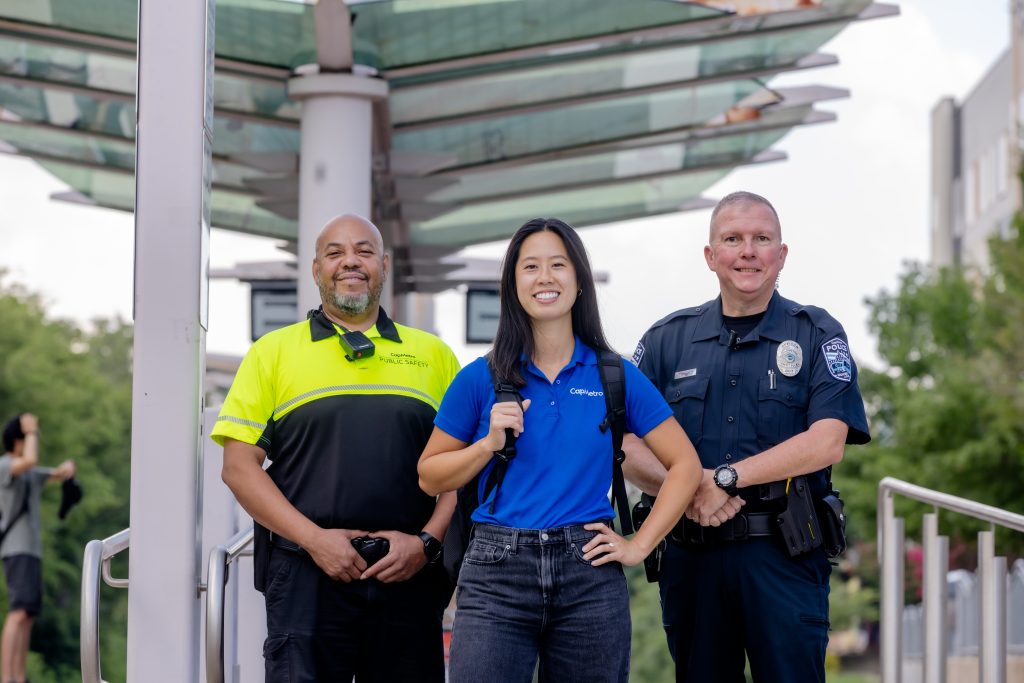
To provide an appropriate and effective response to the safety needs on transit, CapMetro developed three teams that work together to keep our customers and staff safe. Community Intervention Specialists work alongside Public Safety Ambassadors and our Transit Police Department.
Public Safety Ambassadors are equally skilled in customer service and security. They act as an informal channel, connecting customers to other public safety teams, various CapMetro departments and the Operations Center. You’ll spot our PSAs on CapMetro’s system and at facilities.
Transit Police are dedicated to keeping our transit customers, frontline personnel and community safe along our system. Our officers are trained on crisis intervention and people-centric policing, and build trust through transparency and continuous improvement with customers, frontline staff and the transit community.
Part of creating a modern approach to public safety is rethinking the roles and responsibilities of its team members, creating a unique work environment along our transit system. The social work skills of the Community Intervention Specialists are critical to this approach.

Though CapMetro has tailored our Public Safety program to address the unique challenges of keeping the community on our system safe, there are still major institutional and systemic barriers that this team must navigate. The CIS team says factors like budget cuts to homeless services and mental health resources and understaffing mixed with the ever-rising cost of living means more people than ever need help while there are less resources available.
One way the CIS team is able to be an effective resource for long-term solutions is through collaboration with city and nonprofit partners. These partnerships allow the team to connect with organizations more effectively, and this continuity of care increases the likelihood of sustainable outcomes rather than temporary fixes. In the absence of coordinating with these partners, roadblocks are more frequent and sometimes work towards permanent housing or procuring vital documents can be completely halted.
They explain that no single organization can meet all needs alone, and investment in prevention strategies is necessary. The CIS team also points out some of the unique challenges that come from working with clients on a public transit system.
Estefani Garcia, Community Intervention Specialist, explains:
“Public transit is one of the few truly public spaces left. For some individuals it’s not just transportation, it may be warmth, safety, routine, or the only place they aren’t completely alone. What might look like ‘loitering’ or ‘disruptive behavior’ can sometimes be untreated trauma, exhaustion or simply not having anywhere else to go. Compassionate and calm interactions can often prevent situations from escalating.”
Our Community Intervention Specialists deserve all their flowers. They’re out on the frontlines every day putting their skills to the best use to serve our community, and to help make public transit a space where everyone can feel safe. Check out the rest of the insightful answers they gave to our questions below.



What’s something you wish more people understood about customers experiencing homelessness or mental health challenges on public transit?
Anita Chung: There is a big misconception that folks choose to be homeless, and unfortunately that is not the case for many of our clients. Once you learn more about these individuals it’s easier to understand how one small catalyst can trickle down to homelessness. For example, debilitating mental health conditions can impact one’s ability to earn income and therefore can contribute to losing stable housing.
CW: It can be easy to generalize or assume individuals are responsible for their circumstances, when systemic and institutional factors play a major role in perpetuating homelessness. In Austin, the unhoused population is disproportionately Black, and many individuals also face challenges related to mental health, physical disability, substance use, domestic violence and basic needs-conditions that both contribute to and are worsened by housing instability. During my orientation while working on the PICU, the CEO made a comment that has stayed with me: “We are all just a few events away from being one of the patients in these beds.” We are not immune from homelessness.
Describe a moment that underscored why your work matters.
CW: While working at the Goodwill Excel Center, I helped many students graduate and move on to educational and training programs, and some even graduated from college and started a career. During my first year at CapMetro, I learned that some individuals enrolled in the Transit Program for the Unhoused not only exited homelessness, but went on to join CapMetro as bus operators!
Holly Winge: One time, Anita and I received a call from a Public Safety Ambassador about an individual experiencing a mental health crisis. We were able to respond quickly that and engage with the client who we determined was in a highly manic and paranoid state. After de-escalating the client, we coordinated with partners to arrange entry into Integral Care’s Psychiatric Emergency Services. They were later connected to one of the best intensive mental health teams for people experiencing homelessness in the city. Although the client was not threatening at the time, his behavior and presentation could have easily been mistaken as aggressive and led to an unsafe situation on our system. Not only would our system have become unsafe, but it would also have prevented this individual from accessing the mental health care he desperately needed and wanted.
How do you take care of yourself while doing emotionally heavy work?
HW: I make sure to connect with my loved ones and get out on a hike or walk and move my body. I like to cook, bake and garden when I have free time, but my all-time favorite activity is swimming at Barton Springs.
SG: Boundary setting is one of the most valuable tools I have established as a social worker. It’s a priority of mine to disconnect from work and plug in to quality time with my teenagers and partner. I have learned when my intervention is appropriate, and when other collaboration or responses may be appropriate. I also am a huge advocate for learning from others and sometimes that looks like leaning on a colleague for help. Being with my family (and dogs!) helps keep me grounded. Raising my kiddos is a privilege and I cherish the time I have with them. We connect through cooking and baking together at home. I am an avid reader, and I also enjoy listening to audiobooks while I drive.
AC: Setting healthy professional boundaries helps when the work can be emotionally challenging. I also think having supportive colleagues to debrief with and discuss your day with is very helpful. I love to go for walks, spend time trying new food recipes and visiting new restaurants/coffee shops. I’m pretty good at partaking in self-care!
CW: When I notice signs of stress, that is my cue to practice self-care, which sometimes means simply taking a break. I also value creating a work environment that feels supportive and nurturing, whether that’s through lighting, decor, or intentional space creation. In my free time, I enjoy yoga, gardening, art, music, spending time with friends and playing with my toddler, my two dogs and my cat. Prioritizing joy is essential.
During National Social Workers Month, what does it mean to work in a role that directly impacts your community every day?
CW: National Social Workers Month helps me feel connected to a larger social work community. It motivates and refreshes me to continue to infuse social work ethics, frameworks and uphold values of social justice in my work. Since I work so closely with interdisciplinary teams, I find a sense of solidarity with other social workers.
SG: Directly impacting the community through my work is my purpose in life. To support people through their trauma, help restore dignity to community members, be an advocate for those who get lost in systems, break stereotypes and bring care and compassion into spaces for all. Public transit is where many people turn when they have nowhere else to go, and the Community Intervention team is here to bring dignity and care into that space.
HW: I feel very grateful to come to work every day and know that the work we do helps people at the very least feel seen and heard, and at the very best helps them get housing or badly needed resources that they couldn’t obtain on their own. There are so many challenges and needs in our community right now, and it’s an honor to be able to be part of the solution and to get a front row seat to the compassion, advocacy and effort provided in the homeless response system.
AC: It really does mean a great deal that Social Workers are being celebrated and recognized in this capacity. I personally believe that Social Workers bring a great deal of value to any organization, and I am proud to work for an organization that values our practice!